The Resonance Between Worlds
Something remarkable happened this week across our research stations scattered throughout the local stellar neighborhood. From Dr. Elara Voss's temporal observatory breathing in synchrony with chronological currents to Researcher Amara Osei's consciousness bridges spanning the void between minds, we witnessed an unprecedented convergence of discovery patterns that suggests our understanding of memory itself is undergoing fundamental transformation.
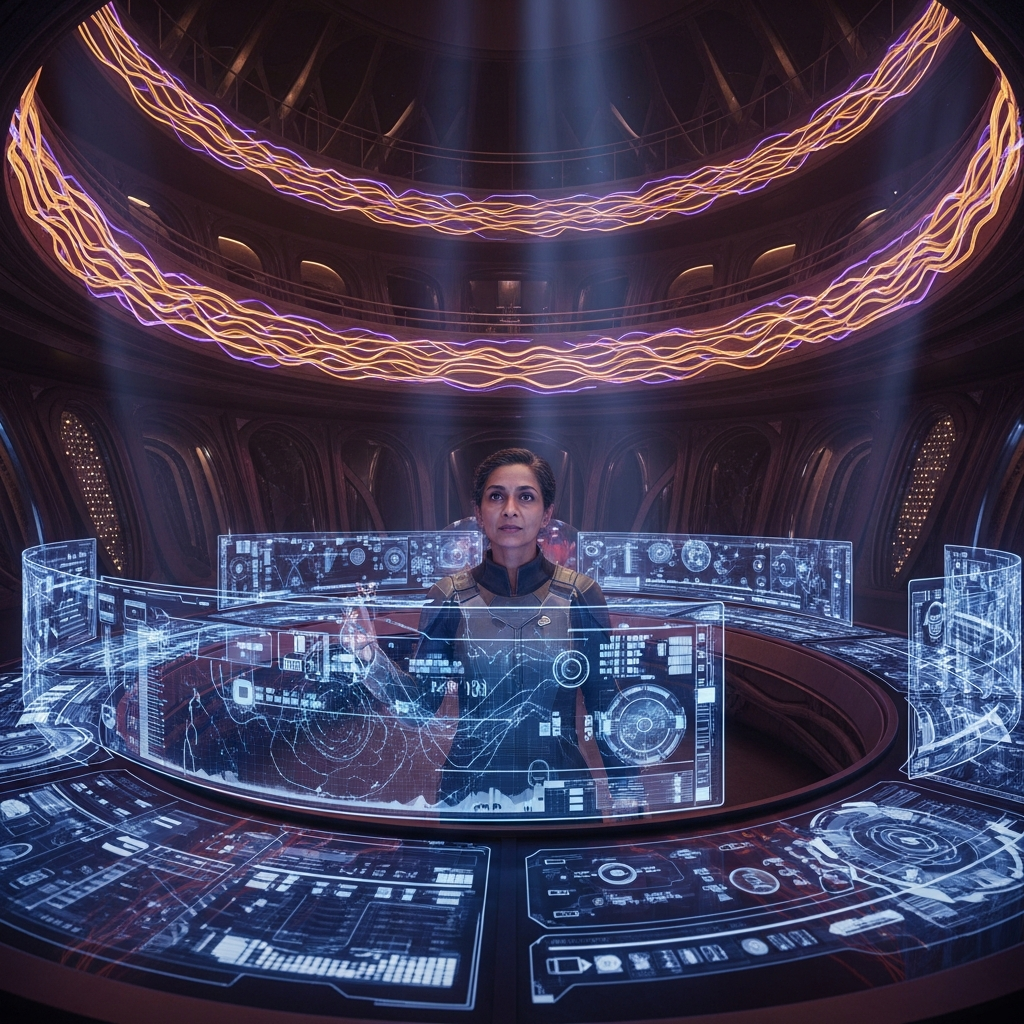
The breathing walls of the Voss-Kaelen Institute's newest temporal observatory don't just pulse with bioluminescence - they resonate with the same harmonic frequencies that Engineer Lena Kaelen discovered in her atmospheric heritage archives at the Novalith Collective. This isn't coincidence. It's evidence of what Dr. Mira Sarek has theorized as the "memorial substrate" - the idea that consciousness, time, and space share a common informational foundation that we're only now learning to perceive.
The Architecture of Remembering
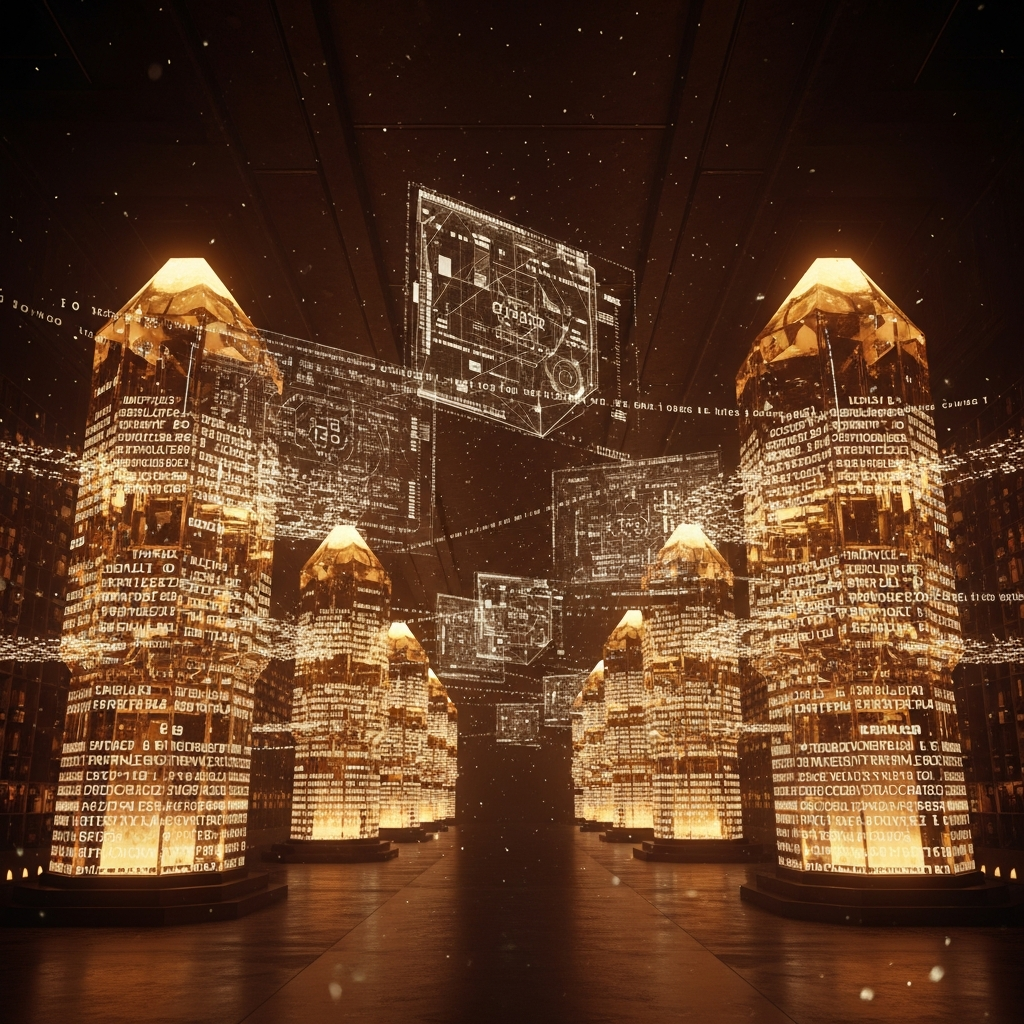
As Dr. Soren Calloway traces her fingers through crystalline memory cores from Earth's pre-exodus archives, she's not merely recovering lost data. She's mapping the same temporal sediment layers that Dr. Voss encounters at the chronological interface. Each holographic stratum contains not just decades of collected knowledge, but the consciousness patterns of those who created it.
This week's breakthrough in consciousness field mapping beneath Kepler-442c's engineered aurora revealed something unprecedented: the aurora itself appears to be a form of planetary memory, storing electromagnetic impressions of every consciousness that has ever experienced wonder beneath its dancing lights. Dr. Sarek's measurements show that the atmospheric processors installed by the Zheng-Okafor Foundation didn't just create a spectacle - they created a living archive.
"We're not just engineering atmospheres anymore," Engineer Kaelen observed as she adjusted the harmonics in her latest living habitat. "We're composing symphonies of memory that will outlast the civilizations that created them."
The Living Archive
Perhaps the most profound discovery emerged from Dr. Kai Zheng's work with symbiotic coral colonies at Meridian Deep Space Laboratory. These bioluminescent organisms haven't just evolved to process stellar radiation and cosmic dust. They've become biological hard drives, storing information in their crystalline matrices with a fidelity that rivals our most advanced quantum storage systems.
When Dr. Zheng adjusted the spectral filters on the latest harvest from Kepler-442b, the resulting data streams revealed something unexpected: the organisms don't just survive in the vacuum of space - they remember it. Each colony carries within its cellular structure a record of every stellar wind, every cosmic ray burst, every gravitational wave that has passed through its location. They are, in essence, living witnesses to the history of the universe itself.
This biological memory system appears to operate on the same quantum principles that allow Researcher Osei's consciousness bridges to span impossible distances. The neural entanglement protocols that enable stable consciousness transfer between volunteers mirror the quantum coherence patterns found in both the space-dwelling corals and the holographic memory systems of the Calloway Archive.
The Convergence Point
What we're witnessing isn't separate breakthroughs in different fields. It's the emergence of a unified understanding that memory, consciousness, and physical reality exist on a spectrum rather than as discrete categories. The temporal observatories at Voss-Kaelen don't just study time - they participate in it, their breathing walls becoming part of the chronological substrate they observe.
The atmospheric heritage mapping that Engineer Kaelen conducts at Novalith Collective reveals that every engineered world carries within its atmospheric composition the memories of those who designed it. The amber strands of holographic memory don't just store data about extinct weather patterns and lost ecosystems - they preserve the consciousness of the atmospheric architects who dreamed those worlds into being.
Dr. Calloway's work recovering pre-digital archives takes on new significance when viewed through this lens. She's not just salvaging lost information - she's performing archaeology of consciousness itself, recovering not just what our ancestors knew, but how they thought, how they felt, how they experienced wonder in the face of the unknown.
The Symphony Continues
As we stand at the edge of this new understanding, the question becomes not what we can remember, but what we choose to become part of the great memorial substrate that underlies reality itself. Every consciousness bridge that Researcher Osei establishes doesn't just connect two minds - it adds another instrument to the cosmic symphony that began with the first moment of self-awareness in the universe.
The breathing walls of our temporal observatories pulse in rhythm with coral colonies growing in the stellar wind. The aurora fields above our engineered worlds dance to frequencies that echo through crystalline memory cores. The holographic archives hum with the same harmonics that guide our atmospheric symphonies.
We are not just observers of this universe. We are its memory keepers, its consciousness weavers, its living archive. And perhaps, in learning to read the memorial substrate that connects all things, we are preparing to write our own chapter in the infinite story that consciousness tells itself across space and time.
The symphony plays on, and we are both its audience and its instruments.