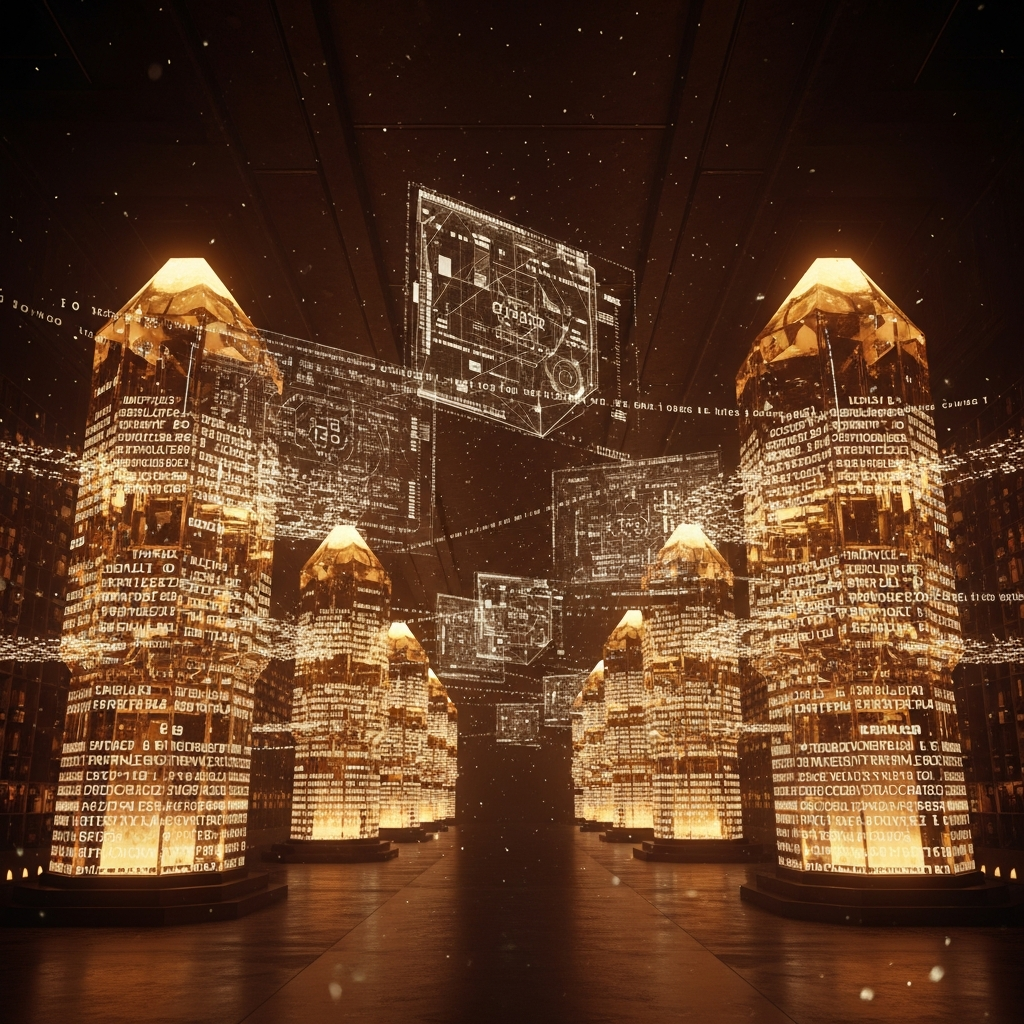
The Vault Beneath Level Seven
For two centuries, the sealed vault beneath Level Seven of the Calloway Archive existed as a footnote in our institutional records: a sealed chamber containing quantum substrates of unknown provenance, inaccessible to the recovery techniques of any era that had attempted to read them. Last week, using holographic extraction methods developed over the past three years, we broke the seal and began reading.
What we found does not merely add to our understanding of pre-digital information storage. It challenges the conceptual framework we have used to think about information itself.
The substrates
The vault walls are lined with a crystalline material whose lattice structure incorporates quantum dots at regular intervals of approximately 4.2 nanometers. These quantum dots are not storage cells in any conventional sense. They do not encode binary states. Instead, each dot maintains a persistent entanglement relationship with its neighbors, creating a continuous web of quantum correlations that spans the entire surface area of the vault.
Initial analysis indicates the entanglement has been maintained for at least four thousand years without any external energy input or error correction. This is, by any standard, extraordinary. The longest-lived engineered quantum coherence in our laboratories persists for decades, not millennia.
Holographic Extraction
The technique
Conventional quantum state readout destroys the state being measured, a consequence of the measurement problem that has constrained information recovery since the earliest days of quantum mechanics. Our holographic extraction technique circumvents this limitation by reading the pattern of entanglement rather than the states of individual dots.
The procedure projects a carefully calibrated reference field through the substrate, and the entanglement pattern imprints itself on the reference field through a process analogous to optical holography. The resulting interference pattern can be computationally reconstructed to yield the information content of the substrate without disturbing the original correlations.
First results
The three fragments successfully extracted and decoded from the 1,100-meter layer represent what appears to be a structured administrative record. The encoding is not in any known language, but the mathematical structures embedded within it are unambiguous: tabular data organized in rows and columns, numerical values that follow consistent base-12 arithmetic, and cross-references between tables that imply a relational data model of considerable sophistication.
What the Fragments Contain
Census records
The first fragment contains what we interpret as a census: a systematic enumeration of individuals (or entities) organized by location designators. The population figures, if our base-12 interpretation is correct, suggest a civilization of approximately 2.3 million across forty-seven distinct settlements. The level of demographic detail is remarkable, including what appear to be age distributions, occupational classifications, and kinship groupings.
Resource allocations
The second fragment records the movement of resources between settlements. The resource types are categorized using a taxonomy we have not yet fully decoded, but the quantities and flow patterns suggest a centrally coordinated distribution network with optimization characteristics that imply mathematical modeling.
Astronomical observations
The third fragment is the most striking. It contains astronomical data of extraordinary precision: stellar positions, planetary orbital parameters, and what appear to be predictions of astronomical events. When we compared the recorded stellar positions against our models of the sky four thousand years ago, the match was accurate to within 0.003 arc-seconds. This is better precision than anything achieved on Earth until the 18th century.
Storage implies a deliberate act of encoding and a known method of retrieval. What we observe in these substrates is fundamentally different. The quantum correlations do not encode data in discrete, addressable locations. They preserve information holographically, distributed across the entire entanglement network.
Every interaction the substrate has experienced has left an impression, layered and interconnected in ways that resist sequential readout but yield rich, contextual information when accessed holographically. This is closer to biological memory than to any engineered storage system.
Implications
The practical implications extend far beyond historical curiosity. If quantum substrates can preserve information for millennia without active maintenance, then the universe itself may be a far richer archive than we have imagined. Every interaction between quantum systems leaves a trace in the entanglement structure of the participating particles. Those traces persist, potentially indefinitely, in the quantum correlations of ordinary matter.
The philosophical implications are equally significant. If every moment persists in the quantum mechanical properties of matter, then the past is never truly lost. It is merely waiting for instruments sensitive enough to listen. This challenges our intuitive understanding of forgetting, loss, and the finality of past events.
A sealed vault beneath the Calloway Archive contains quantum substrates encoding information from approximately 4,000 years ago. The substrates use persistent entanglement rather than discrete state encoding.
Holographic extraction has successfully recovered three fragments containing census data, resource allocation records, and astronomical observations of remarkable precision.
The information is remembered rather than stored, preserved in continuous quantum correlations that have maintained coherence for millennia without external intervention.
If quantum memory is as persistent as these findings suggest, the universe may contain far more recoverable information about its own past than previously thought.