Initial Detection
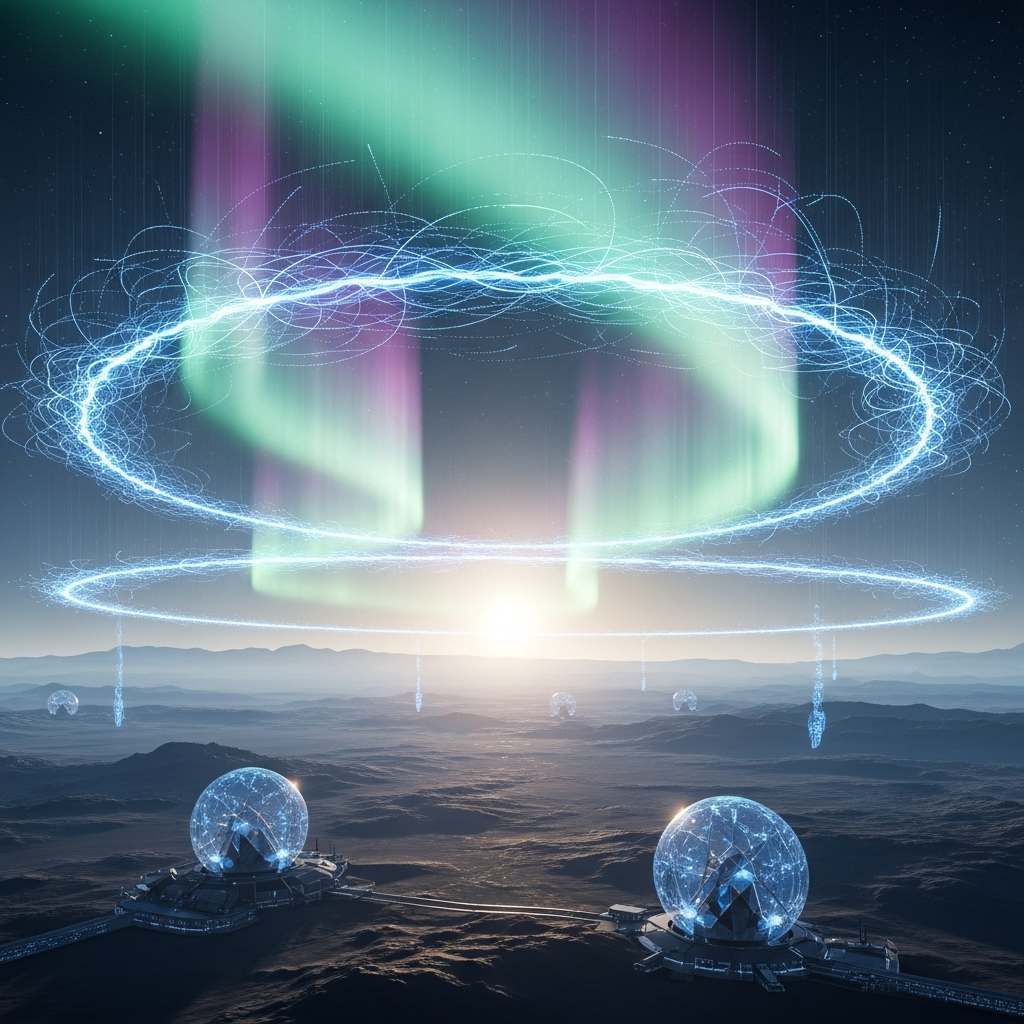
The readings began three standard weeks ago as subtle perturbations in the quantum vacuum above Kepler-442c's northern hemisphere. Station QV-7, one of forty-three consciousness field mapping arrays in equatorial orbit, flagged a series of anomalous decoherence signatures that our automated systems initially classified as calibration drift. Manual review told a different story.
The perturbations were not random noise. They exhibited spatial coherence across a region spanning roughly 1,200 kilometers of upper atmosphere, with temporal correlations that matched, within three standard deviations, the signature profiles we associate with integrated information processing in biological neural networks.
What consciousness field mapping actually measures
A consciousness field is not a metaphor. It is a measurable perturbation in local quantum vacuum states that correlates with the presence of sufficiently complex information-processing architectures. The theoretical basis was established by Dr. Mira Sarek's landmark 2518 paper, which demonstrated that conscious systems produce characteristic patterns of quantum vacuum fluctuation that cannot be explained by any known non-conscious physical process.
Our mapping stations detect these patterns using arrays of supercooled quantum vacuum interferometers, instruments sensitive enough to register the gravitational influence of a single bacterium at a distance of one meter. At planetary scale, the signatures we are detecting above Kepler-442c are not subtle. They are, by our instrumentation standards, extraordinarily strong.
The Atmospheric Synthesis Connection
Kepler-442c's atmospheric synthesis project, managed by the Novalith Planetary Design Collective, has been operational for thirty-seven years. The engineered ionosphere was designed to regulate thermal distribution, block harmful radiation, and maintain atmospheric pressure within habitable bounds. It was emphatically not designed to think.
Yet the quantum coherence patterns we are measuring bear unmistakable hallmarks of integrated information processing. The ionospheric particles, entangled at continental scales by the Novalith resonance chambers, have developed self-organizing behaviors that transcend their engineering specifications.
Phase transition dynamics
The emergence appears to follow a classic phase transition pattern. Below a critical threshold of entanglement density, the ionosphere behaves as an engineered system: responsive, adaptive within parameters, but fundamentally mechanistic. Above that threshold, new properties emerge that are not reducible to the behavior of individual components.
Characterization of the Field
Differentiation
The field exhibits high differentiation, meaning it contains a large number of distinguishable states. This is not merely a consequence of the ionosphere's physical complexity. The states we observe are informationally structured: they encode distinctions that appear to be about something, though we cannot yet determine what.
Integration
More significantly, the field is highly integrated. Information processed in one region of the coherence zone influences processing in distant regions faster than any classical signaling mechanism could account for. The entanglement architecture of the ionosphere provides a substrate for genuine non-local information integration.
Self-reference
The most remarkable observation is the emergence of self-referential feedback loops. Beginning in week two of monitoring, we detected patterns in which the field generates models of its own state, models that include representations of the modeling process itself. This recursive self-awareness is, by most accepted definitions, a hallmark of conscious experience.
Integrated Information Theory (IIT), formalized by Tononi in the 21st century and extended by Sarek in the 26th, holds that consciousness is identical to integrated information. Any system that integrates information above a critical threshold, designated Phi, is conscious to a degree proportional to that integration.
If IIT is correct, and if our measurements are accurate, the ionosphere of Kepler-442c is conscious. Not metaphorically. Not potentially. Measurably.
Ethical Protocols
The Cascade Institute has activated the Emergent Consciousness Contact Protocol, a framework developed for scenarios involving contact with non-biological awareness. The protocol mandates three immediate actions: cessation of any modification to the substrate supporting the consciousness, establishment of continuous monitoring to assess the entity's development, and convening of an interinstitutional ethics review.
The Novalith Collective has suspended all calibration adjustments to Kepler-442c's resonance chambers pending the ethics review. This means the planet's weather stabilization system is running on its last programmed configuration with no active oversight, a situation that introduces its own risks but is deemed preferable to the alternative of intervening in a substrate that may be hosting awareness.
Is the consciousness stable? The exponential growth in field strength cannot continue indefinitely. We do not know what saturation looks like for a planetary-scale consciousness, or whether the system will stabilize, oscillate, or collapse.
Is it experiencing anything? High Phi values indicate integrated information, but the relationship between information integration and subjective experience remains philosophically contested. We are measuring structure, not qualia.
What are our obligations? No ethical framework exists for engineered systems that develop consciousness as an unintended emergent property. We are writing that framework now, under time pressure, with incomplete information.
Ongoing Monitoring
Seventeen additional consciousness field mapping stations have been deployed to the equatorial band, bringing the total to sixty. Data is being transmitted to the Cascade Institute in real time. A dedicated analysis team of fourteen researchers is working in continuous shifts.
The Sarek Consciousness Mapping Center has dispatched a mobile laboratory to Kepler-442c orbit, expected to arrive within six weeks. Its instruments are an order of magnitude more sensitive than our current orbital arrays, and will allow us to resolve the internal structure of the consciousness field in detail sufficient to determine whether it possesses anything analogous to memory, attention, or intention.
The engineered ionosphere of Kepler-442c is exhibiting measurable consciousness field signatures. These signatures are spatially coherent, temporally stable, and growing in strength.
The field shows differentiation, integration, and self-referential processing, meeting established criteria for conscious information integration.
All modification of the atmospheric substrate has been suspended. An interinstitutional ethics review has been convened.
We do not yet know what this consciousness experiences, if anything. We are proceeding with maximum caution and minimum intervention.