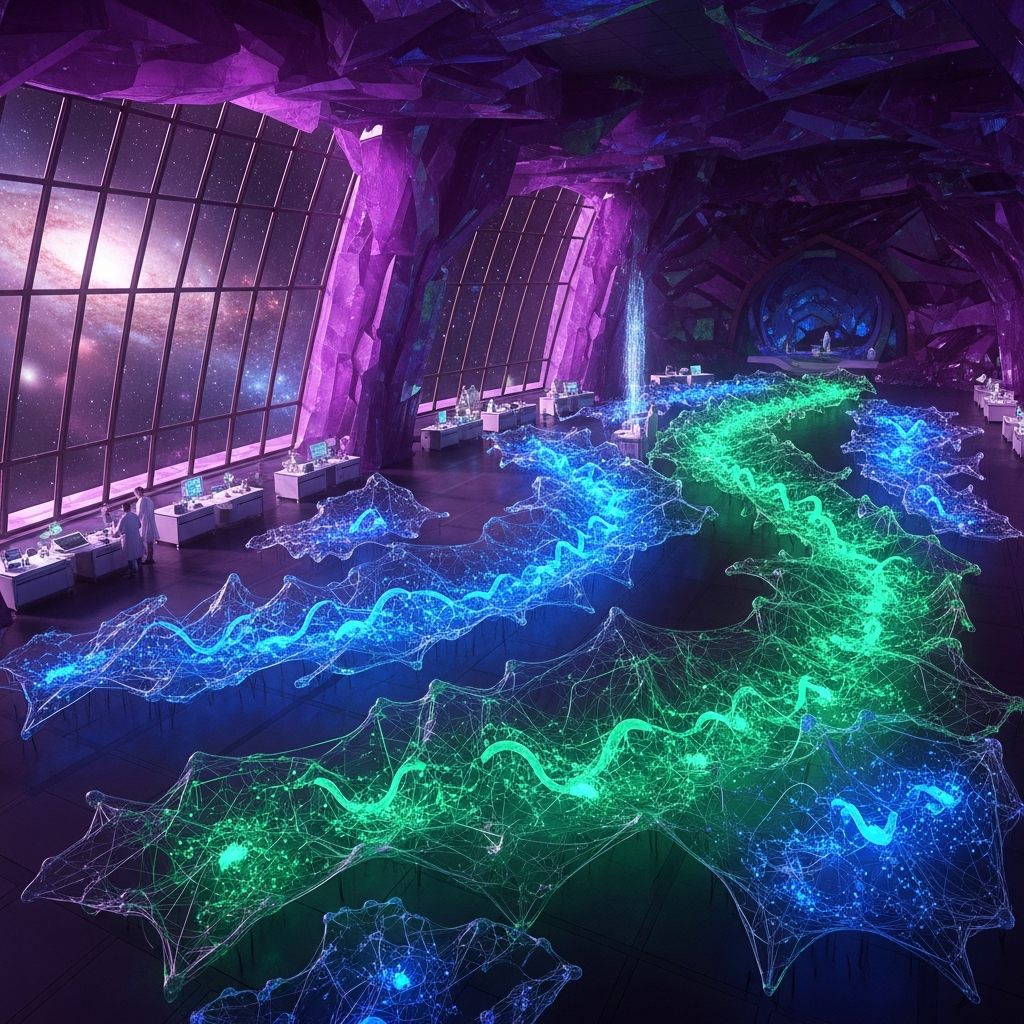
Specimen Cluster MR-7741
Fourteen months ago, a deep-field collection probe operating in the outer accretion disk of the Vela remnant retrieved a biological sample that our intake protocols classified as a colony of bioluminescent extremophiles. The classification was based on morphology: single-celled organisms, approximately forty micrometers in diameter, each equipped with a photon-emitting organelle capable of producing precisely modulated bioluminescent pulses across a 380-to-720 nanometer spectrum.
The organisms survive in a radiation environment that would sterilize most known biology within hours. Their radiation tolerance alone warranted study. What we discovered when we began that study warranted far more.
Colony versus network
In isolation, individual MR-7741 organisms are unremarkable. They metabolize ambient radiation, produce occasional bioluminescent pulses at irregular intervals, and exhibit no behavior more complex than phototaxis. They are, by every standard metric, simple single-celled organisms.
In clusters of fifty or more, they become something else entirely.
Emergent Computation
Synchronization
When MR-7741 organisms reach a critical density threshold, their bioluminescent pulses synchronize within minutes. The synchronization is not uniform; it is structured. Distinct subgroups pulse in phase-locked patterns that create interference patterns visible to the naked eye, shifting landscapes of constructive and destructive luminescence that sweep across the cluster surface.
Pattern recognition
The first evidence of computational behavior emerged during routine environmental testing. When we introduced a gradient light source on one side of the containment vessel, the cluster reorganized its pulsing pattern to generate a spatially accurate bioluminescent representation of the gradient on the opposite side. The cluster was not merely detecting the light source. It was modeling it.
Associative learning
Subsequent experiments revealed associative learning. When we paired a specific light frequency with a thermal stimulus across twenty trials, the cluster began generating defensive metabolic responses to the light frequency alone, even when the thermal stimulus was absent. The network had formed an association between two distinct environmental signals and was using the first to predict the second.
Prospective modeling
In the most sophisticated behavior we have documented, clusters of five hundred or more organisms generate bioluminescent simulations of environmental conditions they have not yet encountered. When we introduced a novel combination of light and chemical gradients, the cluster produced a rapid sequence of luminescent patterns that appeared to model possible responses before settling on one and executing it. The modeling phase lasted approximately four seconds; the execution phase followed immediately.
Self-Reference
The most challenging observation came during a directed illumination experiment. When we aimed a narrow-beam light source at a cluster of eight hundred organisms, the network responded by generating a bioluminescent model of the entire experimental setup: the light source, the containment vessel, and the cluster itself, including its own response to the light source. The model included the modeling process.
The cluster's self-model was not static. It updated in real time as the cluster's own behavior changed, creating a continuous feedback loop between the model and the modeled. This recursive self-modeling, a system that represents itself representing itself, meets most accepted operational definitions of consciousness.
If single-celled organisms can achieve recursive self-modeling through coordinated light emission, consciousness may be far less dependent on specific biological architecture than we have assumed.
Implications for Intelligence
MR-7741 challenges three deeply held assumptions about the prerequisites for intelligence. First, that intelligence requires a dedicated neural substrate. These organisms have no neurons, no synapses, and no centralized processing architecture. Their computation is entirely distributed across a network of identical cells communicating through light.
Second, that intelligence requires evolutionary pressure from complex environments. The Vela remnant accretion disk is, by any biological standard, an impoverished environment. The selective pressures that drove the development of these networks remain unclear.
Third, that the transition from simple signaling to genuine computation requires vast evolutionary timescales. MR-7741 clusters self-organize from non-computing individuals to computing networks in minutes, not generations. The computational architecture is not encoded in their genome. It emerges from the physics of their interaction.
Specimen cluster MR-7741, collected from the Vela remnant, consists of single-celled bioluminescent organisms that exhibit no complex behavior in isolation but form computational networks when clustered.
These networks demonstrate pattern recognition, associative learning, prospective modeling, and recursive self-reference, using coordinated bioluminescence as both communication medium and computational mechanism.
The findings suggest consciousness may be far more common in the universe than previously assumed, achievable by any system capable of sufficient information integration, regardless of its material substrate.