The Echo Between Past and Future
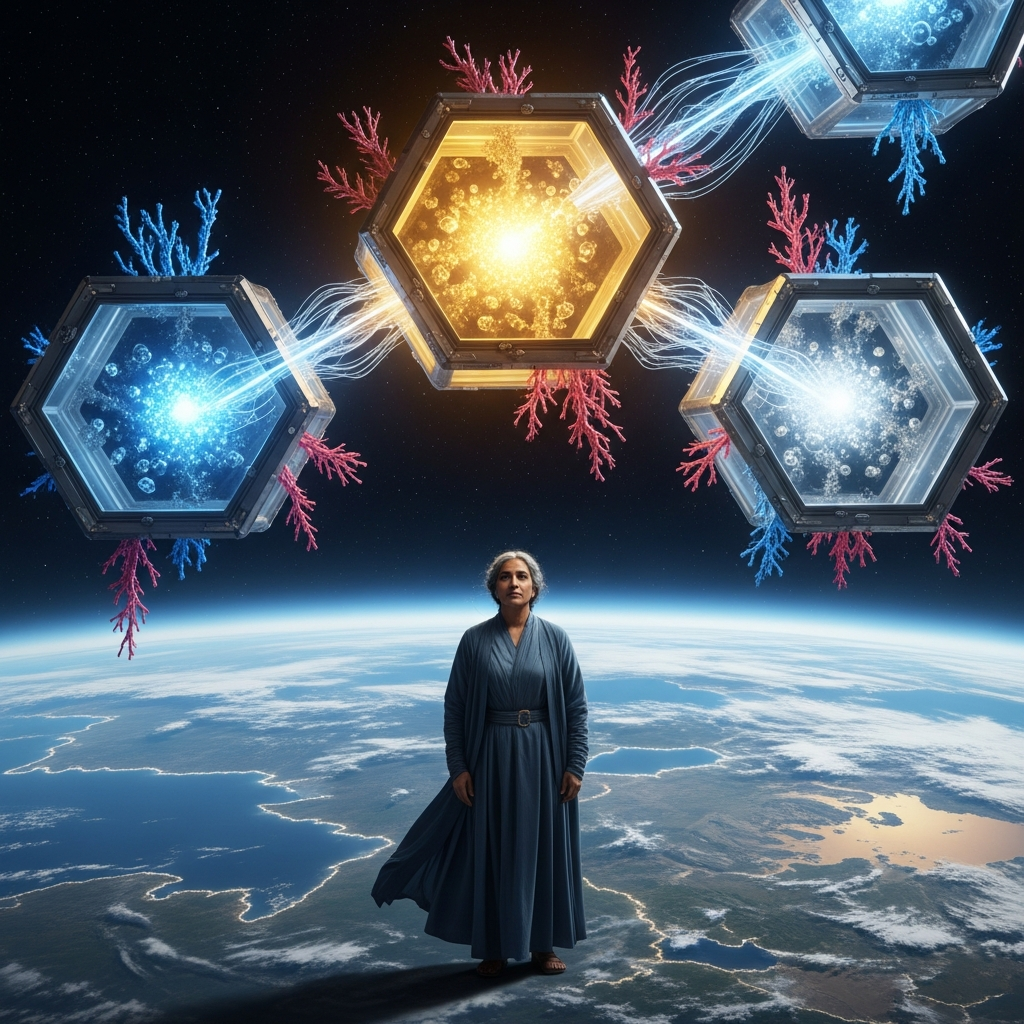
There is a peculiar synchronicity happening in our laboratories this week - one that speaks to the deeper patterns of how knowledge moves through time. At the Calloway Archive, Dr. Soren Calloway's team has been working through the night, their resonance chambers humming as they extract atmospheric compositions from pre-digital memory crystals recovered from Kepler-442b's debris field. Meanwhile, three systems away, Engineer Lena Kaelen stands in her observation pod above Kepler-442c, watching as her atmospheric processors weave those same ancient formulas into the breathing rhythm of three distinct biomes.
The convergence is not coincidental. As our civilization spreads across stellar distances, we find ourselves increasingly dependent on the wisdom encoded in fragments of worlds that came before us.
The Architecture of Forgotten Atmospheres
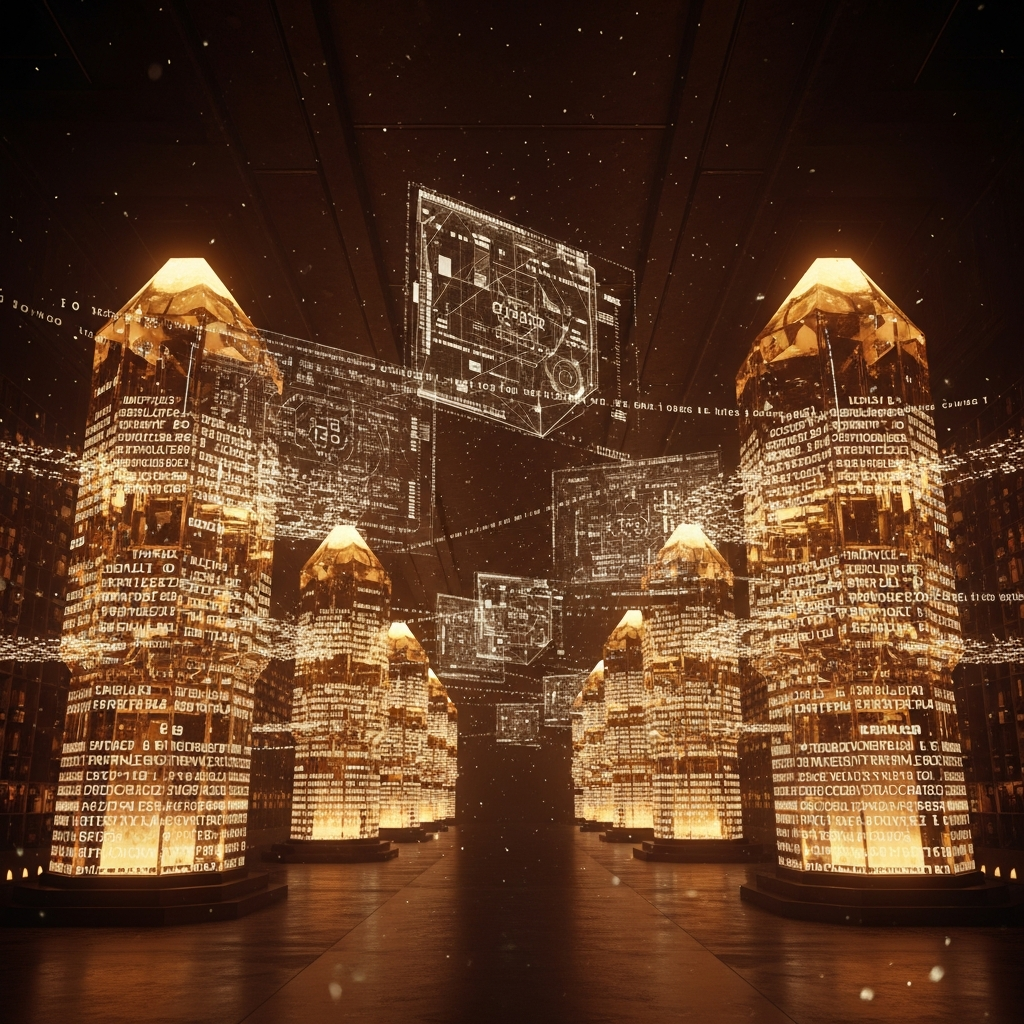
The memory crystals that Dr. Calloway's team recovers are not merely data storage - they are crystallized atmosphere, frozen moments of planetary breath that somehow retain the electromagnetic signatures of ancient synthetic biology. When these fragments emerge from the resonance fields, they carry with them blueprints for atmospheric compositions that our current models suggest should be impossible.
"The pre-digital civilizations weren't just engineering atmospheres," Dr. Calloway observed during this week's excavation beneath the Sarek Center. "They were composing them. Each layer we decode reveals a kind of atmospheric music - pressure variations that created specific resonance patterns, chemical gradients that guided evolutionary development in ways we're only beginning to understand."
Engineer Kaelen has been implementing these recovered compositions at Novalith Planetary Design Collective's newest terraforming project. Her crystalline atmospheric processors above Kepler-442c now breathe in synchronized rhythm, each biome's respiratory cycle timed to the ancient patterns found in the memory crystals. The result is something unprecedented: engineered ecosystems that feel... alive in a way that purely synthetic atmospheres never have.
The Quantum Thread of Memory
What makes this week's discoveries particularly fascinating is how they intersect with Researcher Amara Osei's breakthrough in neural entanglement at the Sarek Consciousness Mapping Center. Her latest findings suggest that consciousness itself might be woven into the quantum signatures that Dr. Calloway extracts from the memory crystals.
"We're seeing neural resonance patterns in the crystallized atmosphere that match the quantum fields generated by conscious thought," Osei explains, adjusting the quantum resonance chambers in her laboratory. "It's as if the act of atmospheric engineering by these ancient civilizations left imprints of their consciousness in the very air they created."
This revelation has profound implications for Dr. Mira Sarek's work at the Voss-Kaelen Institute, where consciousness meets chronology. Her latest temporal perception mapping has revealed that consciousness experiences time differently when exposed to these ancient atmospheric patterns. The time-dilation effects are subtle but measurable - consciousness itself seems to recognize something familiar in these recovered compositions.
Stellar Biology and Ancient Wisdom
Perhaps most intriguingly, Dr. Kai Zheng's stellar organism cultivation aboard Meridian Deep Space Laboratory has begun responding to the atmospheric patterns encoded in the memory crystals. His third-generation stellar plankton colonies, originally engineered to survive in the vacuum between stars, have started exhibiting behaviors that mirror the biological rhythms found in the ancient atmospheric data.
"The organisms are teaching us something about the relationship between consciousness, atmosphere, and stellar evolution," Dr. Zheng notes from his phosphorescent chambers at Helix Station. "They're not just surviving in space - they're creating micro-atmospheres that follow patterns identical to what Dr. Calloway is finding in the pre-digital archives."
This suggests that the atmospheric engineering techniques of ancient civilizations weren't developed in isolation, but as part of a larger understanding of how consciousness, biology, and stellar environments interconnect. The stellar plankton seem to carry genetic memory of these patterns, responding to the recovered atmospheric compositions as if remembering something they never experienced.
The Living Archive
What emerges from this week's convergence is a new understanding of how civilizations preserve knowledge across deep time. The memory crystals aren't just storage devices - they're seeds of living systems, carrying not just information but the actual patterns of consciousness and biology that created them.
At the Cascade Institute's deep space archive, where Dr. Calloway adjusts temporal resonance fields around the recovered crystals, we can observe this preservation in action. Each fragment contains not just atmospheric data, but the neural entanglement patterns of the minds that designed those atmospheres, the biological rhythms of the organisms that lived within them, and even the temporal perception fields of civilizations that experienced time differently than we do.
"We're not just recovering data," Dr. Calloway reflects, watching as another layer of holographic text emerges from the archives. "We're awakening sleeping worlds. Every atmospheric composition we decode, every neural pattern we map, every biological rhythm we discover - it's all connected. The ancient civilizations didn't just leave us instructions. They left us seeds."
Seeds of Future Worlds
As Engineer Kaelen implements these recovered patterns in the atmospheric processors above Kepler-442c, watching charged particle streams weave through engineered magnetic fields to create artificial auroras, we begin to see the true scope of what we're inheriting. The ancient blueprints aren't just for atmospheres - they're for entire ways of being conscious, of experiencing time, of existing in symbiosis with stellar environments.
The question that lingers as we watch three distinct biomes breathe in perfect synchronization above Kepler-442c is not whether we can recreate these ancient worlds, but whether we can understand what consciousness was like for the beings who created them. In learning to build atmospheres from their crystallized memories, we may be learning to think with their minds.
Perhaps this is how knowledge truly travels across the vast distances between civilizations - not as abstract data, but as living patterns that can be awakened, embodied, and experienced anew.