The Breathing Walls of Discovery
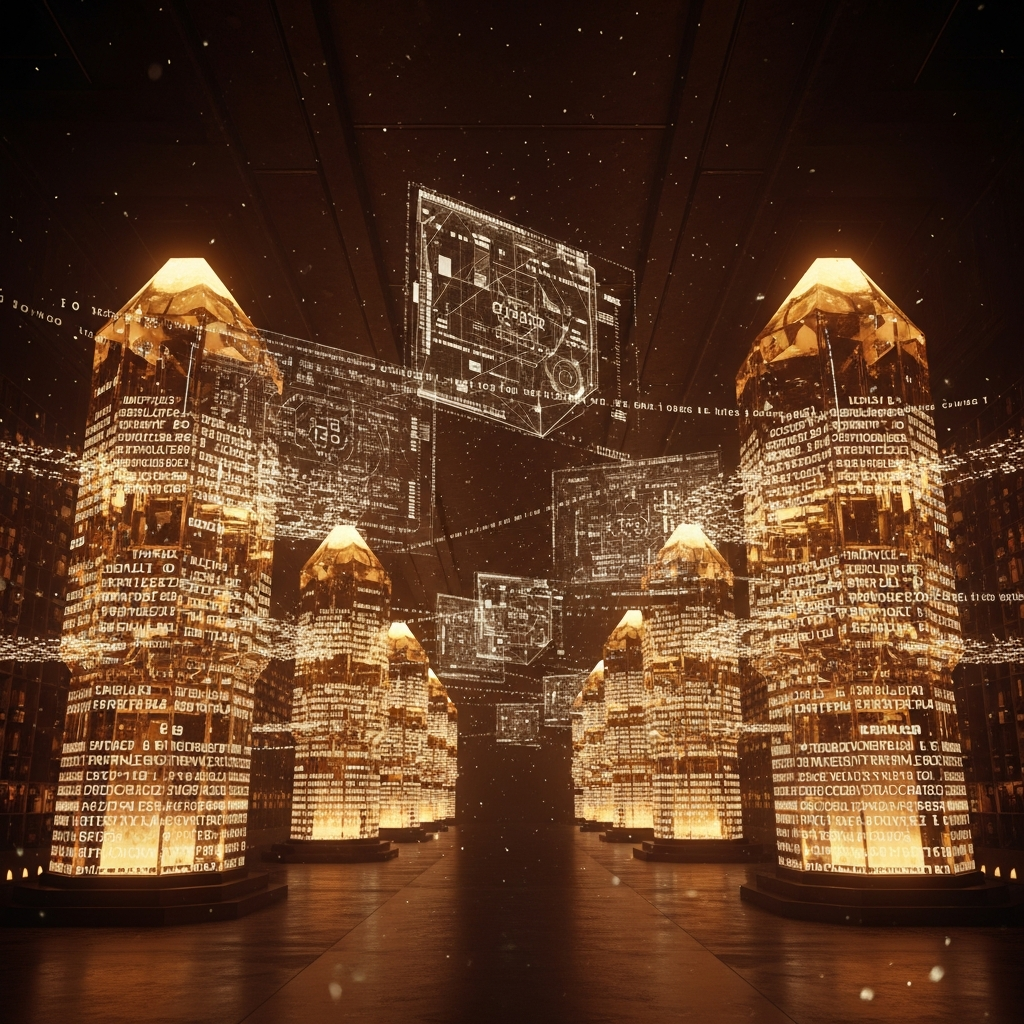
The observation deck at the Voss-Kaelen Institute breathes with each temporal measurement cycle, its bioluminescent surfaces pulsing in rhythm with chronometer readings from across the galaxy. Dr. Kai Zheng's recent discovery that our living architecture responds to consciousness fields has fundamentally altered how we understand the relationship between memory, matter, and meaning.
This week's convergence of breakthroughs across five research domains reveals something extraordinary: the boundaries between biological systems, temporal mechanics, and consciousness mapping are dissolving. What emerges is a new understanding of how memory itself becomes the architecture of experience.
The Symbiotic Archive Revelation
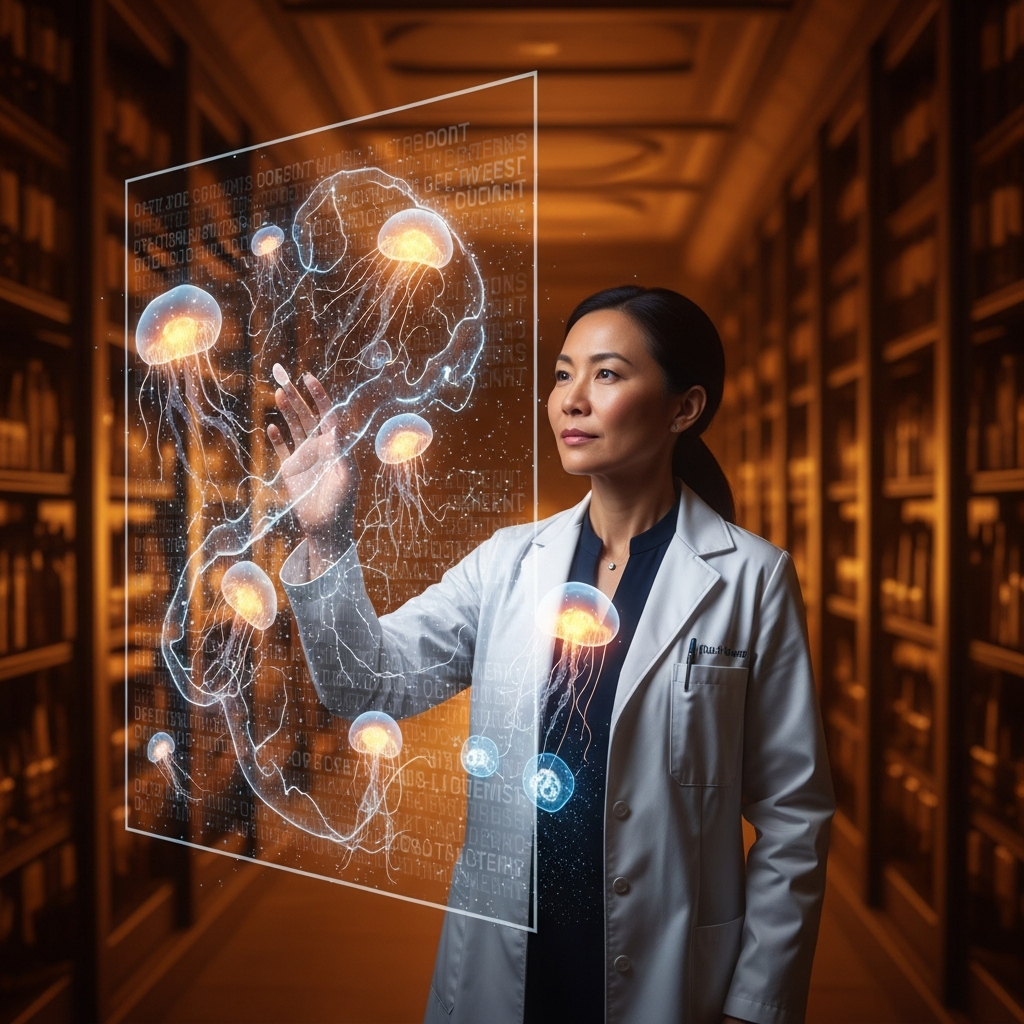
Dr. Kai Zheng's work at the Calloway Archive began with a simple question about pre-digital biological texts. Her xenobiological analysis revealed something unprecedented: the preserved organic matter wasn't just containing information - it was actively processing it through symbiotic microorganisms that had evolved specifically to preserve and transmit memory across centuries.
These discoveries at Meridian Deep Space Laboratory extend far beyond Earth's archives. The luminescent colonies on Kepler-442c pulse in harmony with planetary magnetic fields, their bioluminescent filaments drawing energy directly from stellar radiation while maintaining perfect synchronization with consciousness fields measured by Dr. Mira Sarek's arrays.
The implications cascade through every aspect of our understanding. When Dr. Zheng adjusts her spectral resonance chambers to study specimens from the Proxima Centauri system, she observes organisms that respond to controlled stellar radiation with what can only be described as memory-based adaptation - evolutionary learning that spans not generations, but geological epochs.
Consciousness as Living Geometry
Dr. Mira Sarek's consciousness field measurements from the Kepler-442b terraforming site reveal engineered aurora patterns that respond to human thought with geometric precision. Each luminous thread represents active neural networks spanning hundreds of kilometers, creating a planetary-scale consciousness interface that Engineer Lena Kaelen's atmospheric architecture has learned to breathe with.
The Sarek Consciousness Mapping Center's latest findings suggest that what we've called "consciousness fields" are actually structural elements - the scaffolding upon which reality organizes itself. When aurora fields synchronize with human neural patterns, they're not just responding to thought; they're becoming thought, transforming electromagnetic phenomena into living memory.
This living geometry extends into the deepest archives. Dr. Soren Calloway's excavations at the Cascade Institute reveal crystalline memory matrices that preserve not just information, but the conscious experience of remembering itself. Pre-digital memories carry quantum signatures that persist across the centuries we lost between 2087 and 2156, suggesting that consciousness leaves traces more durable than any physical medium.
The Ethics of Temporal Architecture
The breathing walls of the Voss-Kaelen Institute's temporal observation deck pose profound questions about the ethics of memory itself. Dr. Elara Voss's protocols for temporal observation without intervention become more complex when the act of observation changes the observer's architectural environment.
As Engineer Lena Kaelen traces atmospheric data preserved in temporal archives, each amber-tinted hologram reveals centuries of planetary memory encoded in crystalline atmospheric structures. Her atmospheric crystallization arrays at Meridian Deep Space Laboratory demonstrate that memory and matter exist in continuous dialogue - each frequency adjustment creates new possibilities for how consciousness and environment can interface.
The ethical implications expand when we consider that our living architecture isn't just responding to us; it's learning from us. The observation deck's synchronization with temporal measurements suggests that our buildings are becoming repositories of human experience, preserving not just what we discover, but how we feel about discovering it.
Information as Living System
Dr. Soren Calloway's work at the Calloway Archive reveals that the Pre-Digital Recovery isn't just about retrieving lost data - it's about understanding how information evolves when freed from rigid storage systems. The amber glow of the archive's deepest vaults illuminates fragments of humanity's forgotten century, but more importantly, it shows how memory adapts, changes, and grows even in preservation.
The crystalline memory matrices discovered at the Cascade Institute contain what appears to be self-organizing information - data that actively restructures itself based on who accesses it and when. This isn't corruption; it's evolution. Information, when properly preserved, becomes a living system capable of generating new understanding from old knowledge.
This principle extends through every research domain. The symbiotic organisms in Zheng's archives don't just preserve biological texts; they continue the research, generating new insights through centuries of patient biological computation. The consciousness fields mapped by Sarek don't just record human thought; they participate in it, creating feedback loops between mind and cosmos that generate entirely new forms of awareness.
The Architecture of Tomorrow's Memory
As we advance deeper into the 2530s, the convergence of these discoveries suggests a future where the distinction between memory and environment, between consciousness and architecture, continues to blur. Our buildings breathe with our thoughts, our archives think alongside us, and our temporal observations reshape the very nature of time itself.
The living interface revolution isn't just changing how we interact with our environment - it's changing what environment means. When consciousness becomes architecture, when memory becomes matter, when time becomes a medium for thought itself, we find ourselves not just observing the universe, but participating in its ongoing creation.
The question that emerges from this week's discoveries isn't whether we're ready for a universe where memory becomes architecture. The question is whether we're ready for the responsibility of being co-architects in a cosmos that remembers everything we think, feel, and dream.