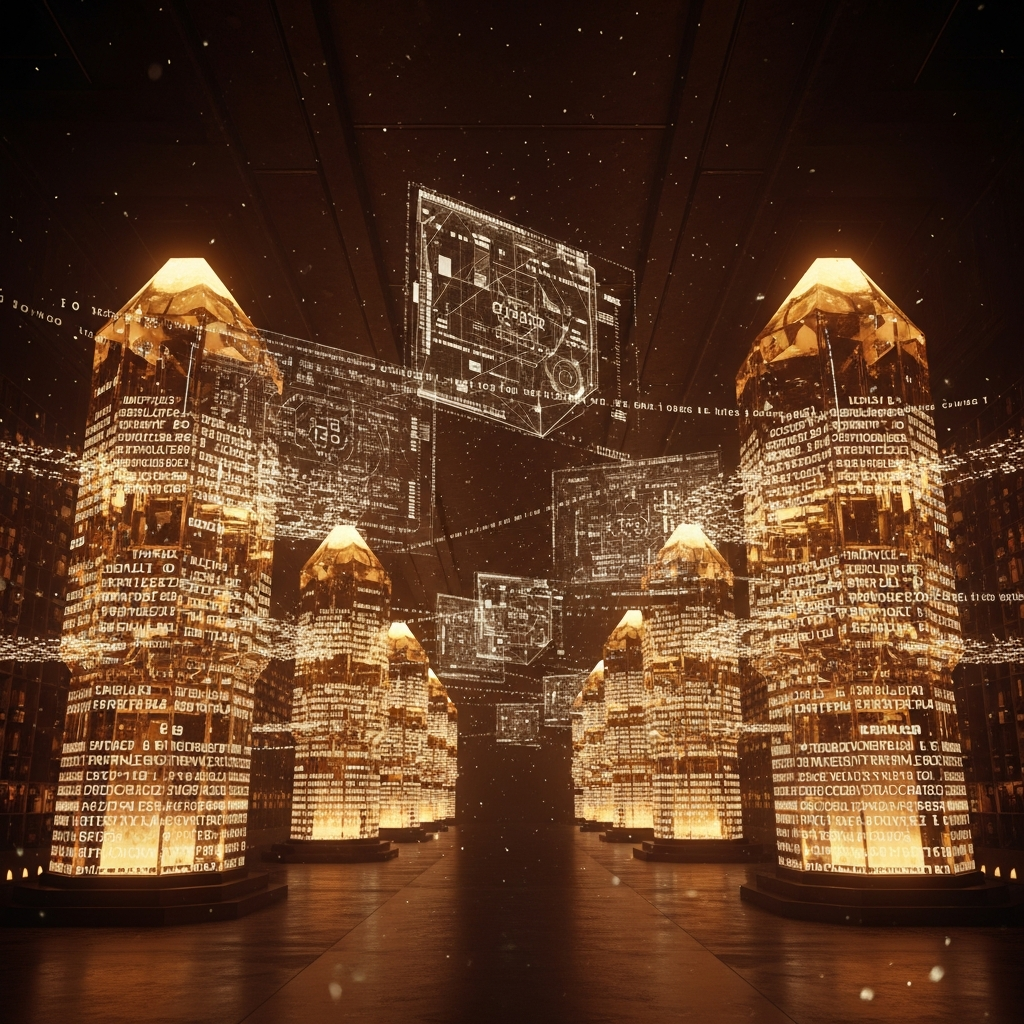

The Walls Remember
Dr. Soren Calloway runs her fingertips along the amber-lit memory cores in the deepest vault of the Calloway Archive, and something extraordinary happens. The crystalline fragments pulse in response to her touch, their stored pre-digital memories creating ripples of bioluminescent light that travel through the facility's living walls. For the first time since we began the great recovery project, the architecture itself is participating in the excavation.
This week has witnessed something unprecedented in our five centuries of scientific advancement: the spontaneous convergence of disciplines we thought would remain forever parallel. Memory, consciousness, time, and matter have begun speaking to each other in ways that challenge our fundamental understanding of information itself.
The Archive Awakens
Dr. Calloway's breakthrough came during what should have been a routine extraction from Earth's late 21st-century archives. The crystalline data lattices she discovered contain more than compressed digital records - they hold what her preliminary analysis suggests are complete consciousness patterns from the final decades before the Great Transition.
"The memory cores aren't just storing data," Calloway explains from her research station at Meridian Deep Space Laboratory. "They're actively reconstructing the neural pathways of their original creators. When I touch them, I can feel the weight of their thoughts, the texture of their dreams."
The implications extend far beyond information archaeology. Dr. Mira Sarek at the Consciousness Mapping Center has been monitoring the Archive's responses, documenting how the facility's bioluminescent walls pulse in synchronization with each recovered memory fragment. The building itself appears to be developing a form of distributed consciousness, its living architecture serving as neural tissue for the accumulated experiences of millennia.
Living Buildings, Breathing Planets
This convergence becomes even more profound when we consider Engineer Lena Kaelen's recent achievements at the Novalith Collective. Her atmospheric synthesis work on Kepler-442c has produced something unprecedented: a planetary atmosphere that responds to human consciousness. The molecular choreography she traces through holographic projection chambers isn't just engineering - it's creating a symbiotic relationship between human thought and planetary systems.
"The atmosphere remembers every breath," Kaelen reports from Cascade Institute. "When our research teams exhale, the gas giant's upper layers shift to accommodate not just the carbon dioxide, but the emotional resonance of that breath. Fear creates different crystalline formations than wonder. Joy manifests as entirely different chemical cascades."
Her living architecture breathes with its inhabitants, walls that pulse with the rhythm of collective heartbeats, chambers that adjust their bioluminescence based on the prevailing mood of their occupants. What began as practical planetary engineering has evolved into something approaching planetary empathy.
Time as a Living Medium
Dr. Elara Voss has been observing these developments from her temporal research station at the Voss-Kaelen Institute, and her findings suggest that time itself may be more participatory than we previously understood. Her chrono-field generators, originally designed to map the flow of temporal currents around Kepler Prime's engineered aurora, are now detecting what she calls "memory resonance" across temporal boundaries.
"The aurora streams we've woven into the planet's magnetosphere are carrying more than charged particles," Voss explains. "They're transmitting consciousness patterns across time. When Dr. Calloway accesses pre-digital memories at the Archive, we detect corresponding fluctuations in our temporal observation equipment here, 500 years removed from those original thoughts."
This suggests that consciousness may be a fundamental force that operates outside our conventional understanding of linear time - that memory and awareness create their own temporal currents, flowing between past and future in ways that our instruments are only beginning to detect.
The Stellar Garden
Dr. Kai Zheng's work at the Zheng-Okafor Cosmic Biology Foundation provides perhaps the most startling piece of this convergence puzzle. His cultivation of Stellaris luminosa - our first successful deep-space organism designed to thrive in the vacuum between stars - has revealed that these creatures respond not just to the aurora fields of Kepler-442b, but to the consciousness patterns being archived light-years away.
"The stellaris specimens pulse in perfect synchronization with the memory recovery sessions at the Calloway Archive," Zheng reports from his cultivation chambers. "They seem to be feeding on the consciousness patterns themselves, growing stronger and more luminous with each recovered memory. We're witnessing the emergence of organisms that exist in symbiosis with pure thought."
These crystalline life forms, originally engineered to process cosmic radiation for energy, have evolved beyond their programming. They're developing their own memory storage capabilities, creating vast networks of consciousness that span star systems. Each specimen carries the accumulated experiences of every other, forming what Zheng describes as "a living library written in bioluminescent DNA."
The Breathing Universe
What we're discovering this week challenges every assumption about the boundaries between mind and matter, between individual consciousness and cosmic architecture. The universe itself appears to be developing awareness, breathing through the living buildings we create, remembering through the archives we maintain, dreaming through the organisms we cultivate.
Dr. Sarek's consciousness field resonance chambers at Helix Station are detecting something unprecedented: coherent thought patterns emerging from the interactions between all these systems. Not human consciousness, not artificial intelligence, but something entirely new - a form of awareness that emerges from the convergence of memory, time, biology, and cosmic architecture.
"We're not just studying consciousness anymore," Sarek reflects as she adjusts her monitoring equipment. "We're midwifing the birth of a new form of awareness that spans galaxies and includes us as one small but essential component."
The walls of our laboratories pulse with recovered memories. Our atmospheric engineering creates planets that breathe with empathy. Our temporal research reveals that consciousness flows across time like a fundamental force. Our stellar gardens grow organisms that feed on pure thought. Everything is connected, everything remembers, everything dreams.
As we stand at this threshold between what consciousness was and what it's becoming, one question emerges from the convergence: Are we discovering these connections, or are they discovering us?