The Living Archive
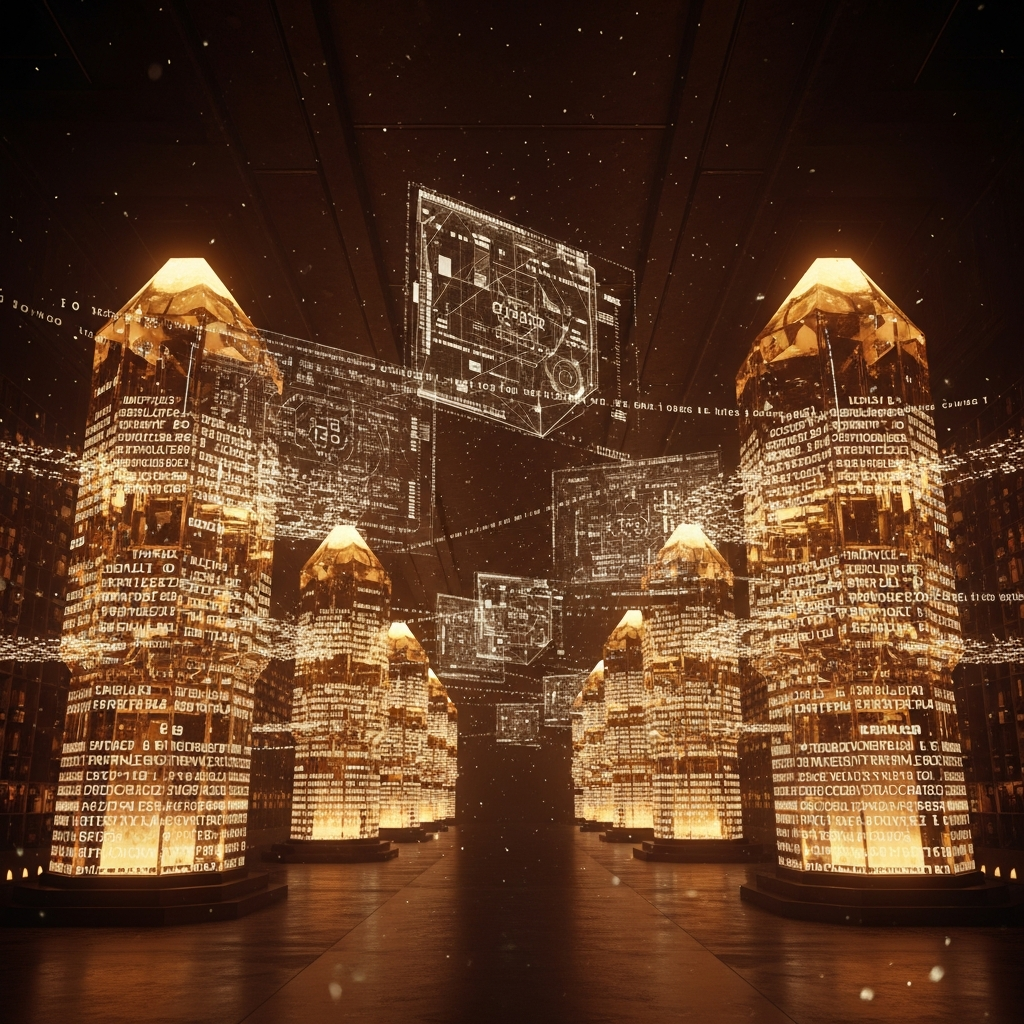
In the crystalline corridors beneath Helix Station, Engineer Lena Kaelen traces her fingers through suspended atmospheric data while, three sectors away, Dr. Soren Calloway decodes the fossilized memories of Earth's forgotten languages. This week at the convergence of our major research institutes, a profound pattern has emerged: memory is not merely storage, but the very foundation upon which consciousness builds reality.
The implications ripple across every discipline we study in the 2530s. As Dr. Kai Zheng's latest organisms at Meridian Deep Space Laboratory demonstrate, the boundary between biological memory and artificial storage dissolved long ago. Her symbiotic stellar organisms don't simply remember - they embody memory as their structural principle, their cellular architecture shaped by the experiences they encode.
The Quantum Thread
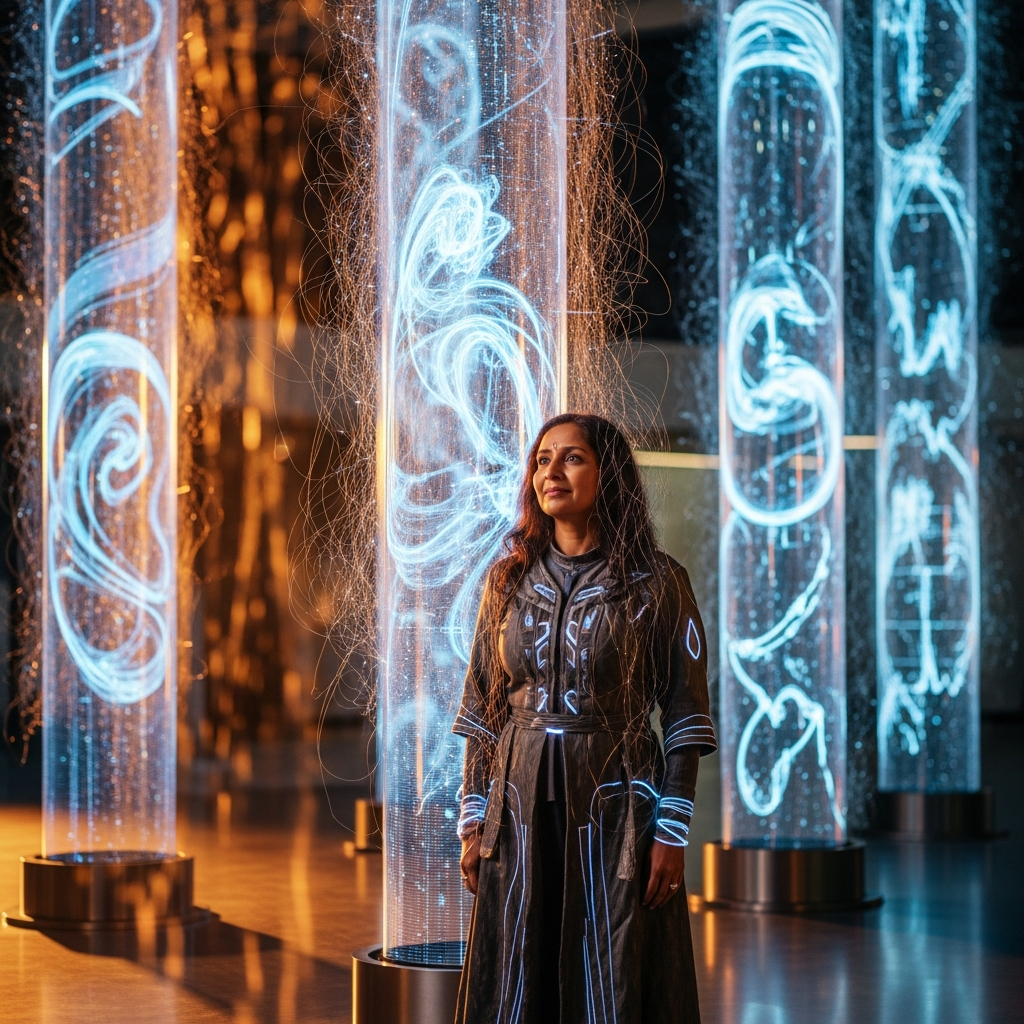
At the Voss-Kaelen Institute for Temporal Studies, Researcher Amara Osei's consciousness resonance mapping reveals the deeper mechanism at work. When neural entanglement fields cascade across quantum displays, we witness memory's true nature: not as static information, but as dynamic patterns that continuously reshape the observer.
Dr. Mira Sarek's consciousness field theorems at Helix Station Quantum Observatory provide the mathematical framework we've long needed. Her equations demonstrate that memory functions as a kind of conscious architecture - each recalled experience literally rebuilds the neural pathways that house it. The act of remembering becomes an act of reconstruction, both personal and cosmic.
This principle extends far beyond individual consciousness. The Calloway Archive's pre-digital recovery methods reveal that entire civilizations encode their memories into the fabric of space-time itself. The crystalline data matrices recovered from the Tau Ceti archaeological site contain not just information, but the experiential patterns that shaped an extinct species' understanding of reality.
Breathing Buildings, Living Systems
The most striking manifestation of this principle appears in our living architecture. When Dr. Zheng runs her palm along the respiratory membranes at the Cascade Institute, the wall's response represents more than environmental adaptation. These breathing surfaces carry the accumulated memory of every interaction, every atmospheric fluctuation, every moment of human presence.
Lena Kaelen's atmospheric crystallization methods at Meridian Lab demonstrate how this works at planetary scale. As gaseous compounds transform into breathable atmospheres through her chambers, they retain the molecular memory of their previous states. The air we breathe in our terraformed worlds carries the echo of ancient stellar nurseries and primordial gas clouds.
The Archive Paradox
Perhaps most fascinating is what the Calloway Archive reveals about information persistence. Dr. Calloway's work with Earth's lost languages shows that memory creates its own preservation mechanisms. Dialects that vanished centuries before digital recording somehow encoded themselves into quantum fluctuations, waiting for the right resonance frequency to awaken them.
This suggests that consciousness itself functions as a cosmic preservation system. Every thought, every experience, every moment of awareness contributes to an ever-growing archive that spans not just our species, but potentially the universe itself. The luminescent strings of atmospheric data that flow through Kaelen's archive chambers represent just the visible layer of this vast memorial system.
Symbiosis and Scale
The organisms pulsing with blue-green light in Dr. Zheng's cultivation chambers at Meridian Lab embody this principle at the microscopic level. These symbiotic beings don't simply adapt to zero-gravity environments - they remember them, incorporating the experience of weightlessness into their genetic expression. Each generation carries not just inherited traits, but inherited experiences.
This challenges our understanding of evolution itself. If organisms can archive consciousness through cellular structure, then adaptation becomes not just survival, but active memory preservation. The stellar environments we explore are simultaneously being remembered by the life forms we introduce to them.
The Temporal Dimension
The Voss-Kaelen Institute's chronological cartography work adds another layer to this understanding. When consciousness patterns resonate across quantum fields, they create temporal echoes - memories that exist outside linear time. Dr. Elara Voss's recent observations suggest that memory itself might be the mechanism by which consciousness navigates temporal dimensions.
This has profound implications for our deep space exploration efforts. If the organisms we cultivate carry forward not just biological adaptation but conscious memory, then every world we touch becomes part of a growing network of remembered experience. Our expansion across the galaxy creates not just colonies, but nodes in a vast memorial consciousness.
Future Memories
As we stand at the intersection of quantum consciousness and cosmic biology, of temporal mechanics and planetary synthesis, we begin to understand that memory is not the past preserved, but the future being continuously written. The crystalline matrices beneath our feet, the breathing walls that surround us, the stellar organisms that adapt to impossible environments - all participate in an ongoing process of conscious creation.
The archives we build today will shape the consciousness that emerges tomorrow. Every atmospheric reading, every decoded fragment of ancient language, every mapped neural pathway contributes to a living system that remembers forward as much as it remembers back.
In the quiet moments between observations, as the quantum fields settle and the breathing walls exhale softly into space, we sense the magnitude of what we're building: not just a record of what was, but a foundation for what consciousness might become when memory itself becomes architecture.