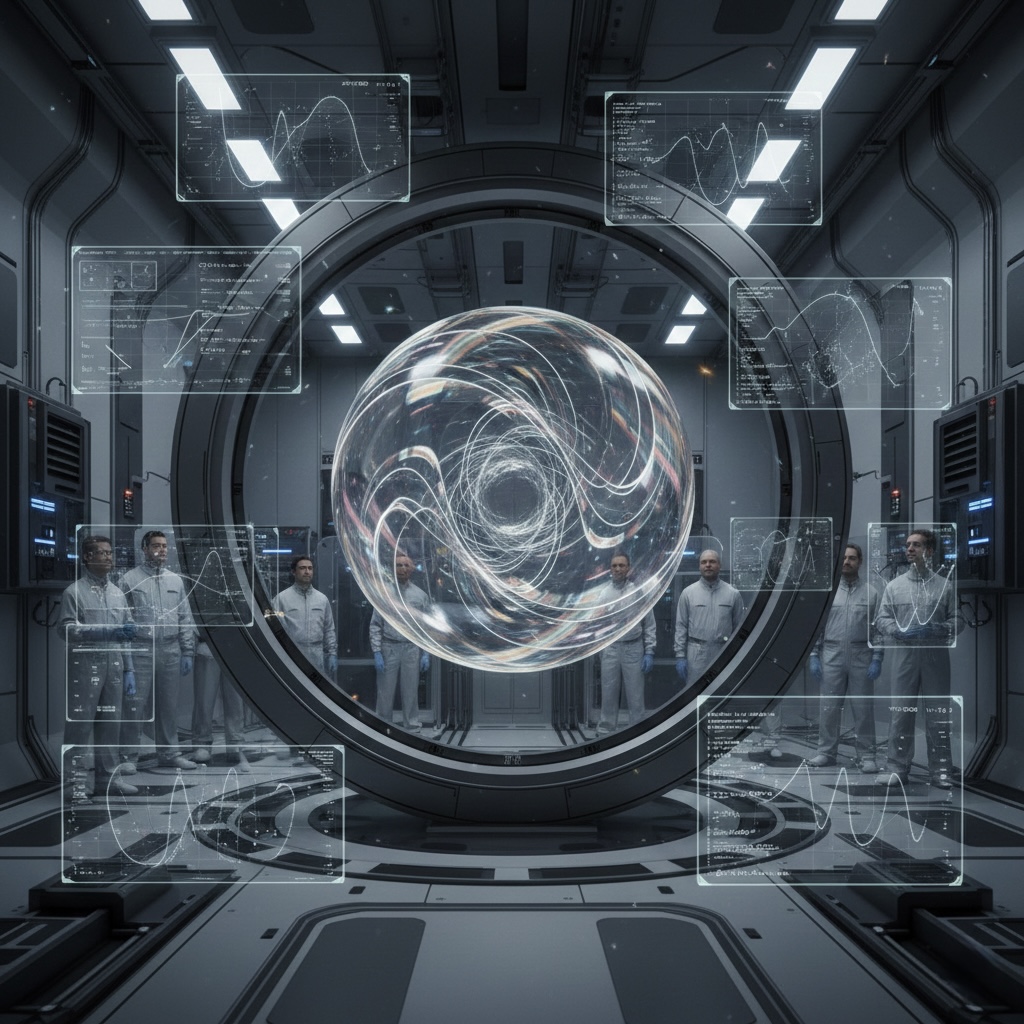
The Scientific Foundation
Temporal displacement was not the product of a single eureka moment. It emerged from three centuries of steady, incremental progress, each generation of physicists building on what the previous one had begun to suspect but could not yet prove.
Quantum Gravity Unification (c. 2090s)
For generations, the deepest unsolved problem in physics was reconciling general relativity with quantum mechanics. The breakthrough, when it arrived, came from an unexpected direction. Rather than finding a way to quantize gravity, researchers demonstrated that spacetime itself is not fundamental. It is emergent.
Beneath the fabric of space and time lies a deeper structure now known as the chrono-informatic lattice, a pre-geometric substrate made up of entangled informational nodes. These nodes carry no inherent spatial or temporal properties. Space and time arise from the pattern of their connections, in much the same way that temperature is not a property of any single molecule but emerges from the collective behavior of many.
This understanding was formalized in the Yuen-Marchetti framework, which showed that the equations of general relativity describe an averaged-out, large-scale view of the lattice's deeper structure. The critical implication was immediate: if spacetime is emergent rather than fundamental, then its seemingly rigid properties, including the forward direction of time and the fixed ordering of cause and effect, are statistical tendencies rather than absolute laws.
Entropic Directionality as a Field (c. 2200s)
Earlier eras understood entropy as a statistical tendency, a description of why disorder increases over time. Our era understands it differently. Temporal ordering is enforced by a field, one we call the entropic gradient field, or more informally, the "time field." This field determines the sequence of events in much the same way the Higgs field determines the mass of particles.
The pivotal discovery was that this field can be locally modified. Not easily, and not cheaply, but it can be done. Within a sufficiently controlled environment, the time field can be dampened, loosening the rigid ordering of "before" and "after" in a contained region.
Causal Topology (c. 2340s)
The final pillar was the development of causal topology, a mathematical framework that describes how events are connected to one another independent of any coordinate system. In this framework, traveling to the past is not a matter of reversing along some universal timeline. It is the restructuring of a local region's causal connections so that a traveler's worldline attaches to a portion of the lattice corresponding to an earlier configuration.
The Mechanism
What is being manipulated
The local configuration of the chrono-informatic lattice. More precisely, a process called topological re-threading detaches a subject's worldline from its current position in the causal network and reattaches it to a target position, one that corresponds to what outside observers would describe as the past.
What conditions are required
Three conditions must be met. First, the target lattice configuration must be mapped in extraordinary detail, a process analogous to reconstructing a complete three-dimensional image of a location from faint echoes and historical records. This mapping takes months and is the primary source of targeting error.
Second, the operation must be conducted in a region of low causal density, meaning a volume of spacetime with minimal entanglement complexity. In practice, this requires deep interstellar vacuum far from any massive objects. The emptier the workspace, the cleaner the re-threading.
Third, the modifications to the time field must be contained within a boundary to prevent them from propagating outward. This containment sphere, typically about two kilometers in radius, is non-negotiable.
Energy requirements
Re-threading a single human-mass worldline across 100 years requires energy comparable to the total output of a mid-sequence star over several hours. For a probe sent 500 years into the past, the cost approaches the total solar energy Earth receives over 40 days. This scale of energy expenditure, sourced from controlled vacuum energy extraction technology developed in the 2400s, is why temporal displacement remains an institutional endeavor rather than a personal technology.
Constraints and limitations
Spatial coupling. Every temporal re-threading is coupled to spatial displacement. Earth rotates, orbits the sun, and moves with the galaxy. Targeting must compensate for all of this motion. Errors of fractions of a percent can result in arrival in open vacuum or inside solid matter.
Resolution decay. The farther back the target, the less precise the lattice maps become. Beyond approximately 800 years, arrival conditions cannot be guaranteed survivable.
Mass limits. Current apparatus can re-thread roughly 10,000 kilograms per operation. Heavier payloads require sequential operations, each compounding targeting error.
One-way travel. Returning to one's origin time requires performing the entire process again from the destination era, using equipment that does not yet exist there. Only robotic probes carrying miniaturized lattice engines can currently make a single round trip. For biological travelers, displacement to the past is effectively permanent.
Paradox Resolution
The Grandfather Paradox
The classical grandfather paradox assumes a single, globally consistent timeline that would have to accommodate contradictory events. The chrono-informatic lattice does not operate this way.
When a worldline is re-threaded into a past configuration, the result is not a modification of the existing causal structure. It is a branch nucleation event. The re-threaded worldline becomes part of a new, distinct causal branch that shares a common history with the origin branch up to the moment of arrival, then diverges.
The branches created by re-threading are not pre-existing parallel universes. They are generated by the displacement event itself, in the same way a fracture in a crystal creates two surfaces that did not previously exist. The origin branch continues unaltered. The traveler's actions have real consequences in the new branch, but those consequences do not propagate backward to the origin.
The past you came from cannot be changed. You can only create a new branch of history and exist within it.
The Information Paradox
Temporal displacement does introduce information into a branch where it was not generated by local processes. The resolution lies in energy accounting: the enormous energy cost of re-threading is not merely transportation overhead. A significant portion of it is the thermodynamic price of instantiating coherent information in a new causal context. Conservation is maintained, but the balance is struck across branches rather than within a single timeline.
Causality
Strict causality is preserved within every branch. No observer inside any single branch will ever witness an effect preceding its cause. Apparent violations only arise when attempting to describe events from a cross-branch perspective, which has no physical meaning, in much the same way that asking "what is north of the North Pole?" is a question without a coherent answer.
The Operational Sequence
A temporal displacement operation proceeds through seven phases, from initial mapping to full stabilization at the target.
Safety, Stability, and Risk
The chrono-informatic lattice is extraordinarily robust. Branch nucleation, while thermodynamically expensive, is structurally benign. The lattice has been undergoing spontaneous micro-branching since its formation, a process earlier eras called quantum decoherence. Deliberate re-threading is a larger-scale, directed version of something the universe already does continuously.
Threading failure. Approximately 0.3% of operations fail at Phase 5. The outcome is invariably fatal. There is no recovery procedure.
Targeting inaccuracy. Lattice map errors can result in arrival in hostile environments, incorrect locations, or partial overlap with solid matter. This is the leading cause of probe loss.
Psychological effects. Roughly 12% of human travelers develop temporal dissociation, a condition characterized by intermittent difficulty distinguishing memory from anticipation. The condition is treatable but not curable with current methods.
Branch isolation. A traveler in a past branch has no means of communicating with or returning to their origin branch without independent re-threading capability. For biological travelers, displacement is functionally permanent.
Containment integrity is critical. Without the causal containment field, time-field suppression would propagate outward, creating an expanding zone of causal disorder. An early containment failure produced a 400-meter sphere in which cause and effect operated non-deterministically for 11 seconds. No personnel were harmed because the workspace was uncrewed. The incident prompted the Yuen Protocols, which now mandate minimum operational distances from inhabited systems.
Regulatory Framework
Temporal displacement is governed by the Terran Compact on Causal Integrity. Its provisions restrict operations to licensed institutions, prohibit displacement of biological subjects without informed consent and psychological screening, and impose an absolute prohibition on targeting any era or location where the arrival could influence the causal chain leading to the development of displacement technology itself.
This final restriction is not motivated by paradox avoidance (branch nucleation makes classical paradoxes impossible). It is grounded in the ethical principle that no civilization should be subjected to externally imposed causal disruption during its formative development.
Spacetime is emergent, not fundamental. It arises from patterns of entanglement in a deeper informational substrate called the chrono-informatic lattice.
The "arrow of time" is enforced by a field that can be locally suppressed, allowing a subject's causal connections to be restructured.
Traveling to the past creates a new branch of history. The original is unaffected. Classical paradoxes do not arise.
The energy cost is staggering, the targeting precision is imperfect, and the journey is functionally one-way for humans. But the physics is sound, the technology is operational, and the universe remains stable.